When you need a pavement licence
The test is simple: does any part of the scaffold sit on, or hang over, land the council is responsible for — the pavement, the verge or the carriageway? If yes, you need a licence under the Highways Act. If the scaffold stands entirely within your own boundary, such as a back garden or a private drive, you normally do not.
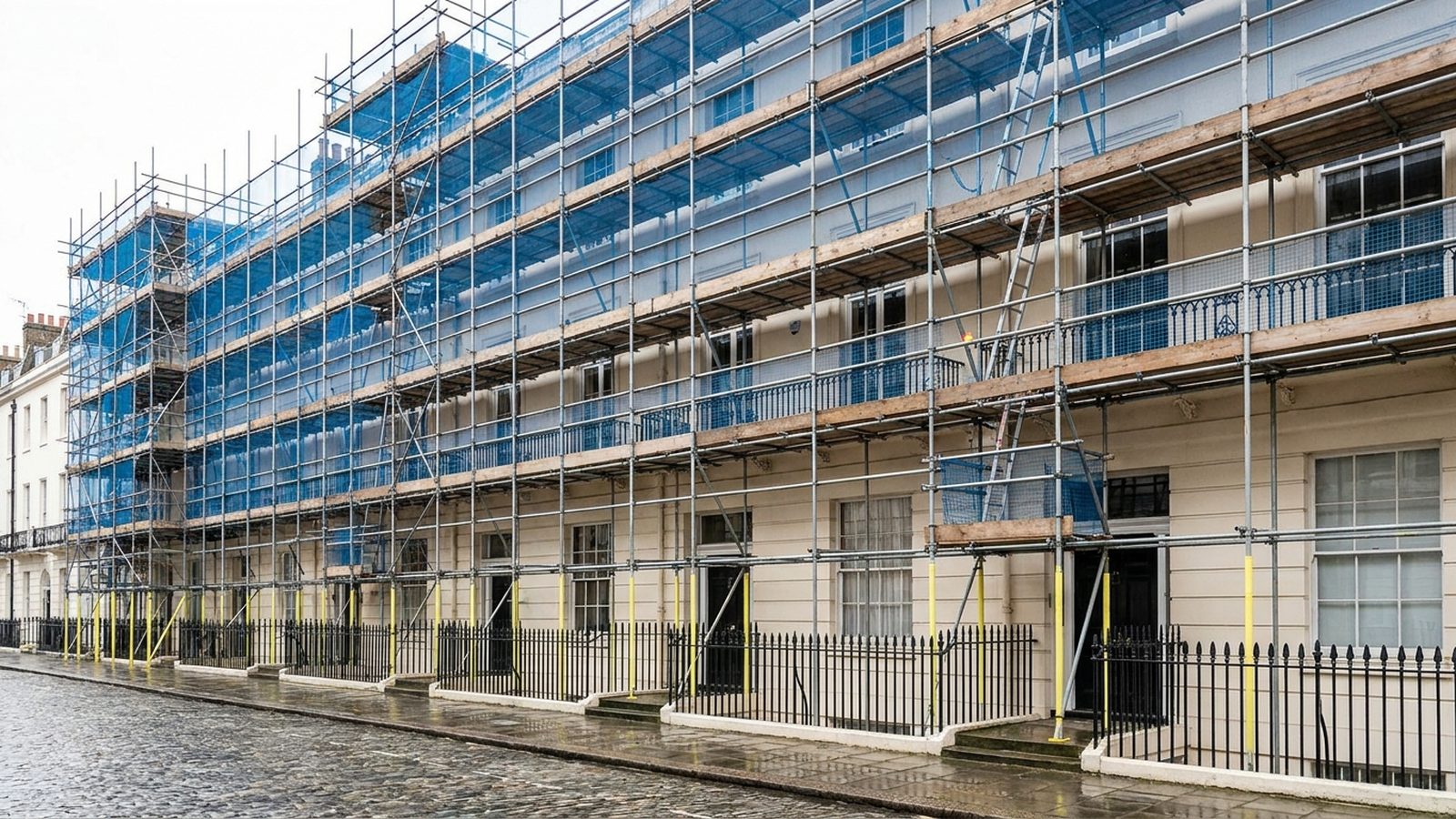
Most London street scaffolds do need one, because terraced and town-centre properties open straight onto the footway with no front garden to build in. A licence is also usually needed where the scaffold occupies a parking bay, which brings a separate parking-suspension request.
Who issues the licence
The licensing authority is the local highway authority — in London that is the borough council for most streets, or Transport for London where the scaffold affects a red route or the TfL road network. Each borough runs its own application, sets its own fee and its own duration, and attaches its own conditions on lighting, signage, hoarding and pedestrian protection.
Because the process and cost differ from borough to borough, we confirm the exact fee, lead time and conditions for your specific address at survey rather than quoting a London-wide figure. Our location pages set out the licensing authority for each area we cover.
Timelines, conditions and insurance
Councils typically ask for several working days' notice to process a licence, and some require longer, so it pays to apply as soon as the works are scheduled. The licence is granted for a set period and can be extended if the job overruns.
Standard conditions usually require the scaffold to be lit at night, fitted with debris netting or fans over public areas, protected with brick guards, and signed clearly. The council will also expect evidence of public-liability insurance for the scaffold on the highway. We meet those conditions as standard and keep the licence valid for the duration of the hire.
- Allow several working days' notice — longer in some boroughs.
- Night lighting on any scaffold over the footway.
- Debris netting, fans and brick guards over public areas.
- Clear signage and, where required, a pedestrian gantry.
- Public-liability insurance evidence for the highway.
We handle the application
You should not have to learn your borough's highways portal to get a scaffold up. As part of the job we prepare and submit the licence application, provide the insurance evidence, meet the council's conditions on the ground, and manage any parking-bay suspension the job needs. If the works overrun, we handle the extension.
Tell us the property postcode and the job through the quote form and we will confirm the current council fee and lead time for your address, and fold the licence into your fixed price.
Related scaffolding services
See also domestic scaffolding, commercial scaffolding, temporary roof scaffolding, or browse all scaffolding services and scaffolding by London area.
Get your fixed-price pavement licence scaffolding quote
Fully insured, TG20:21 designs, up quickly. Call 020 7864 7245, message us on WhatsApp, or use the form above.