Estimate your scaffolding cost
Set the sliders to roughly match your job. The result is a broad, illustrative London market range to help you budget — it is deliberately wide because the true price depends on access, ground conditions and the exact design. It is not our quote, and no figure here is a fixed offer. When you're ready, we confirm the real price free at survey.
Side-return and rear-elevation access for extensions, repairs and painting.
What's driving it: 1 elevation of domestic / extension scaffold; 2 storeys high (each lift adds material and labour).
These are broad typical London market bands to help you budget — not National Scaffolding's price. Every job is priced on a free site survey, then fixed in writing with no hidden extras.
Get my real fixed price — freePrefer a person? Call 020 7864 7245 or message us on WhatsApp and we'll talk it through.
What actually drives a scaffolding price
Almost every scaffolding quote in London comes down to the same handful of variables. Understand these and you'll read any quote — including ours — with confidence, and you'll know when a cheap price is cheap because a corner has been cut.
- How many elevations. Scaffolding one wall of a house is a fraction of the cost of wrapping all four. The single biggest lever on price is simply how much of the building you need to reach.
- Height, measured in lifts. Every additional storey adds another "lift" of boards, standards, ledgers and ties — more material on hire and more labour to erect and strike. A three-storey job is not 50% more than two; it is closer to double.
- How long it stays up. Most quotes include a standard hire period. Keep the scaffold longer — because a build overran or the weather turned — and you pay extended-hire charges by the week.
- Whether it needs a council licence. If any part of the scaffold stands on a public footway or road, your borough requires a highway scaffold licence, which carries a council fee on top of the scaffolding itself.
- Access and ground. A clear front garden is easy. A narrow side-return, a basement lightwell, a roof you have to bridge over, a red route with no standing — each adds design, labour or specialist kit.
- Design and loading. A simple access scaffold for painting is one thing; a fully boarded, sheeted, load-bearing scaffold with a loading bay or temporary roof is another. The heavier the duty, the more material and engineering.
Typical cost by job type
Here is how the common London jobs tend to fall. These are broad market ranges to set expectations, not fixed prices — your job is priced individually.
Domestic scaffolding — extensions, repairs, painting
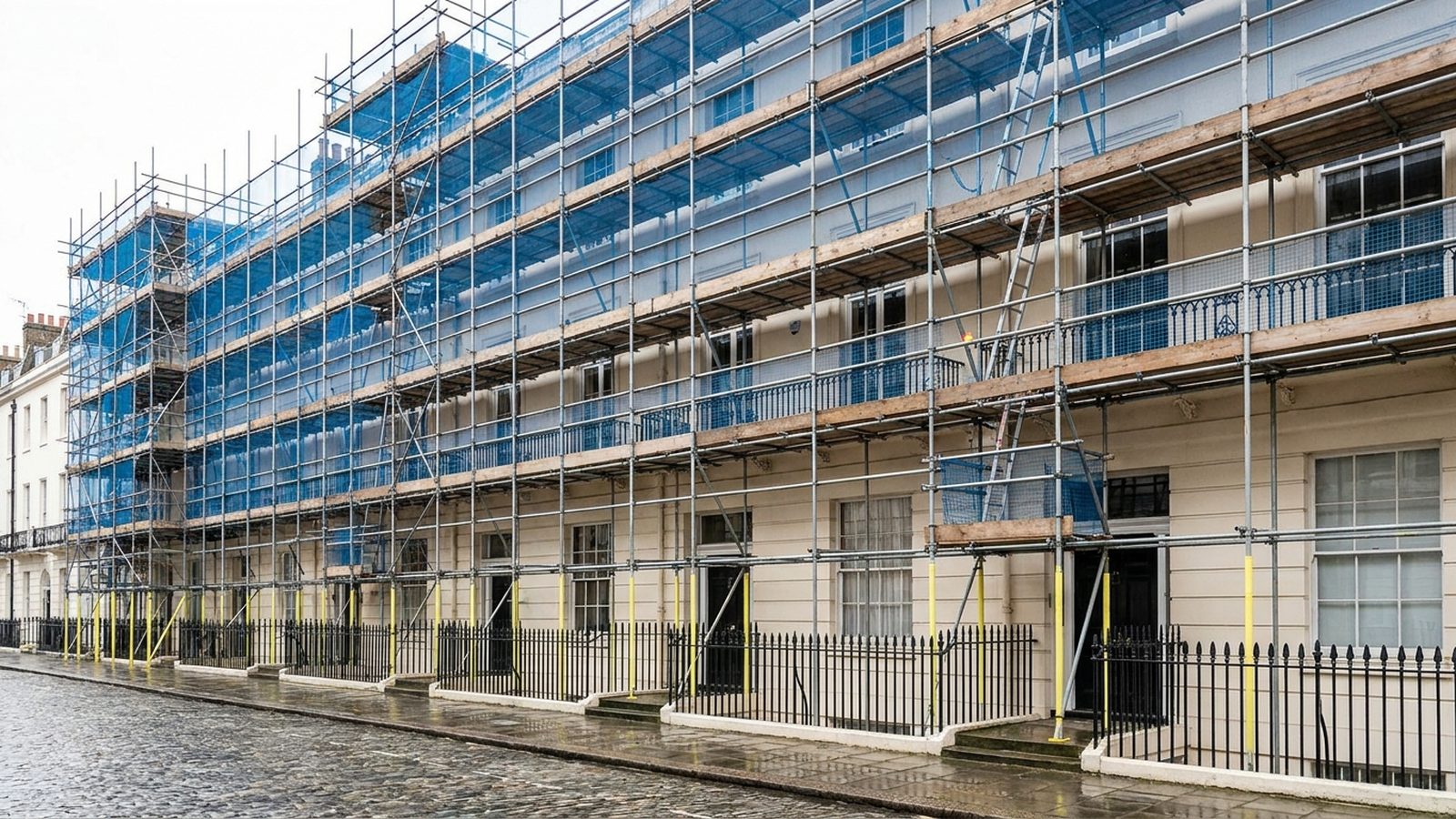
The bread and butter of London residential work: a single rear or side elevation for a builder doing an extension, a gutter or fascia repair, or a decorator painting the front. Because it's usually one or two elevations at two storeys, domestic scaffolding sits at the lower end of the range. The classic Wandsworth or Hackney side-return extension is the typical example — a scaffold threaded down a narrow passage between houses.
Re-roofing and temporary roofs
A re-roof needs a fuller, well-boarded access scaffold around the roof perimeter with edge protection to keep roofers safe. If the roof has to stay open and dry through the works — common on a London re-roof in winter — you add a temporary roof: an aluminium beam structure and weatherproof sheeting over the top. That cover is a real extra, which is why roof jobs span a wider range than domestic ones.
Chimney access
A chimney scaffold looks small but often isn't cheap: to reach a stack you usually build up to the ridge and sometimes bridge over a pitched roof, so height and access — not the size of the chimney — drive the price. On a tall Victorian terrace the access run to the stack can be substantial.
Commercial and new build
Commercial scaffolding covers larger elevations, longer programmes, edge protection, loading bays and — on a busy high street — a pedestrian gantry and licensed hoarding. It sits at the top of the range simply because there's more of everything: more material, more weeks, more compliance. These are quoted from drawings or a site visit against your programme.
Height and the number of lifts
People underestimate how much height costs. Scaffolding is priced on material volume and labour, and both scale with every lift. A single-storey rear return is quick and light. Add a second storey and you've roughly doubled the boards, standards and ties, plus the time up and down. By the time you're at three or four storeys — common on London's tall terraces and mansion blocks — the scaffold also needs more ties into the building and, above certain heights, a design check to TG20:21 or a bespoke engineered design. That's not upselling; it's what keeps a tall scaffold safe and legal.
How long you keep it: hire duration
A scaffolding quote is really two things bundled together: the cost to erect and dismantle, and the hire of the material while it's up. The erect-and-strike cost is fixed. The hire runs for as long as the scaffold stands. Most quotes include a standard period — often around six weeks — and charge extended hire by the week after that.
This matters more than people expect, because building projects overrun. If your builder's eight-week job slips to twelve, the scaffold is up for twelve weeks and you pay the extra. Two ways to protect your budget: get a realistic programme from your builder before you book, and ask us up front what the standard hire period and the weekly extended-hire rate are, so there are no surprises. We put both in writing.
Council highway licences
If your scaffold stands entirely within your own boundary — a back garden, a private drive — you generally don't need a council licence. The moment any part of it sits on the public footway or road, your borough requires a highway scaffold licence before it goes up, and that carries a council fee separate from the scaffolding.
Every London borough sets its own fee and its own duration, and they change them, so we never quote a council fee as a fixed fact — we confirm the current figure with your council and build the lead time into your programme. You can see how the licensing authority and local constraints differ area by area on our scaffolding by London area pages — for example Camden, Islington or Lambeth, each with its own council and process. Our pavement licence scaffolding page explains the application in detail.
Access and site conditions in London
London adds cost that a suburban job wouldn't. Narrow Victorian footways often need a pavement gantry so pedestrians can pass safely under the scaffold. Controlled parking zones mean a bay suspension for the scaffold vehicle and materials. Red routes on TfL roads mean no standing, so deliveries are timed around restrictions. Conservation areas and listed frontages call for careful tie positions to avoid damaging historic brick and stucco. None of these are hidden fees — they're real work — but they're why an identical scaffold can cost more in inner London than elsewhere, and why a proper survey beats a phone quote.
What a proper quote includes — and the extras to watch
A trustworthy scaffolding quote should state, in writing:
- Exactly which elevations and what height are being scaffolded.
- The design duty — access only, or fully boarded and load-bearing — and edge protection.
- The standard hire period and the weekly rate for extended hire.
- Whether a council licence is needed, who applies for it, and that the council fee is separate and confirmed with the borough.
- That the price is fixed after survey, with no hidden extras.
Warning signs of a quote that will grow later: a suspiciously round number given over the phone without a survey, no mention of the hire period, and no line about the council licence when the scaffold clearly hits the footway. A price that looks too good often excludes the licence, assumes a short hire, or skips proper ties and boarding.
How to keep the cost down
- Only scaffold what you need. If the work is on one elevation, don't pay to wrap the house. A good scaffolder designs to the job.
- Book the hire period realistically. Line up trades so the scaffold isn't sitting idle on extended hire while you wait for a roofer.
- Combine jobs. If you're re-roofing and repointing, do them under one scaffold rather than paying to erect twice.
- Get the survey. A free site survey prices the job accurately, which usually saves money versus an inflated phone quote padded for the unknowns.
- Confirm access early. Clear the side passage and sort parking before the crew arrives so nobody's standing around.
How our pricing works
We don't give a made-up figure down the phone and revise it upward later. You tell us the job, we book a free site survey, and we look at the elevations, the height, the access, the ground and whether a licence is needed. Then we give you a fixed price in writing — fully insured, designed to TG20:21 where it applies, with the hire period and any council licence spelled out. No hidden extras. That's the number you pay.
Which trades work off the scaffold — and why sequencing saves money
Scaffolding is rarely the job. It is the platform for someone else's job, and the single biggest avoidable cost on a London scaffold is hire time spent standing idle between trades. The fix is not a cheaper scaffold; it is a programme agreed before the first standard goes up.
Work out which trades need the platform and book them back to back. On a typical terrace that means roofer, then leadwork and gutters, then any repointing or brickwork repair, then external rendering, then painting — each of them handed over to the next without a fortnight of dead hire in between. External rendering is the one that most often gets scheduled late, because it is treated as a finishing job rather than an access-dependent one. A specialist such as London Plastering Service covers rendering as well as internal skimming and dry lining across London, and firms of that kind are usually booked several weeks ahead — worth confirming their start date before you fix the scaffold hire period, not after.
The same logic runs indoors. Where a scaffold is up for a re-roof or a loft conversion, the internal works underneath are usually happening in parallel, and every week the two programmes fall out of step is a week of hire nobody planned for. If the interior side is being handled as a package — a full-service renovation firm such as London Renovate handles bathroom and interior fit-out design, supply and installation together — get their programme in writing at the same time as the builder's. One shared programme, agreed before the scaffold is booked, is worth more than any discount you will negotiate on the scaffolding itself.
Related scaffolding services and areas
Browse the job you need — domestic, temporary roof, chimney, commercial or pavement-licence scaffolding — or find your London area for the local council and access detail. See all scaffolding services.
Get your real, fixed-price quote — free
Skip the guesswork. A free site survey and a fixed price in writing, usually within one working day. Call 020 7864 7245, message us on WhatsApp, or use the form at the top.